You've been training for years.
Your bones haven't.
Muscle and bone answer to different signals. If your scan keeps going the wrong direction despite everything you do, this is the part nobody explained to you.
Disciplined people, falling scans
Someone walks in with a scan that went down again. They lift three days a week. Or they've done Pilates faithfully for eight years. Or boot camp since their fifties, never missing a week. They are not lazy and they did not cut corners. They are astonished.
They shouldn't be. They were training muscle. Nobody was training bone.
Muscle responds to volume
Repetition, time under tension, sets and reps. That works, and it's worth doing for every reason people do it.
Bone responds to magnitude
Peak load — how much force passes through the skeleton in a single moment. Repetition doesn't substitute for magnitude. Ten thousand light repetitions still reads to bone as light.
| What you do | What it's genuinely good for | What it gives bone |
|---|---|---|
| Walking | Heart, joints, mood, longevity | Roughly body weight — the level your skeleton already treats as normal |
| Pilates & yoga | Control, mobility, core, balance | Low load by design. The method working exactly as intended |
| Boot camp | Conditioning, work capacity, consistency | High effort, moderate load. Effort and load are not the same input |
| Weight training | Muscle, strength, metabolic health | Real stimulus — but most adults train well below the multiples of body weight bone responds to |
| Swimming & cycling | Cardiovascular, joint-friendly | Little skeletal loading. Gravity is largely removed |
None of it is wasted. Keep doing it. But if bone density is the goal, none of it is the input.
Two groups do build bone in a gym: elite gymnasts and competitive powerlifters. Both reach loads at multiples of body weight. Neither is a realistic plan for an adult with a job, a family, and a life outside the gym. That gap is the entire reason this studio exists.
You press. Nothing presses back.
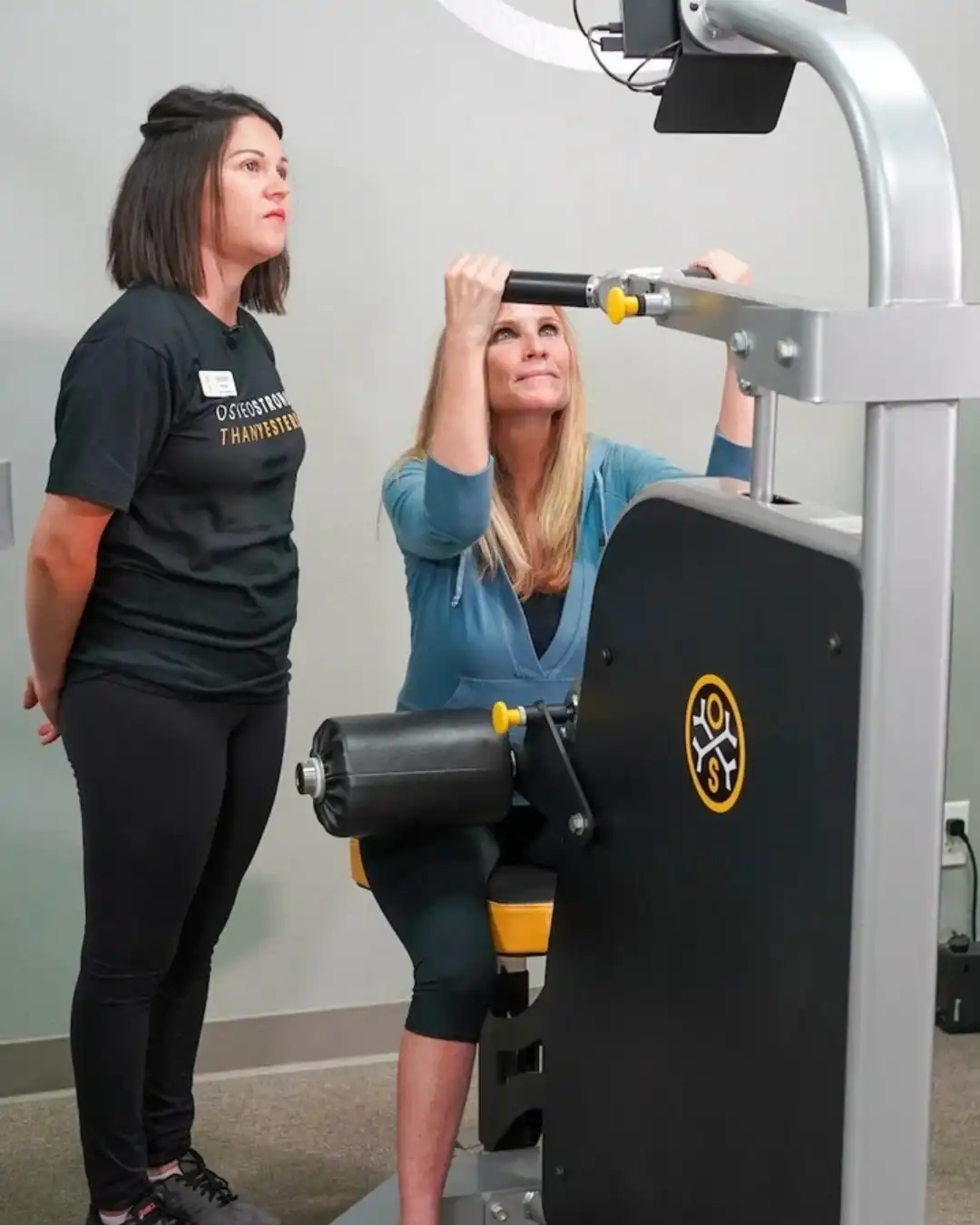
You press into a fixed, supported machine and produce force against it. You control every pound. The resistance never moves toward you, and you can never be loaded beyond what your own body generates. A coach runs the entire session. Four positions. About fifteen minutes. Once a week.
It won't feel like a workout
No sweat, no soreness, no gym clothes. The load is high but it lasts seconds — that's the design. The adaptation happens in your skeleton over months, not in the mirror over days. "That was it?" is the most common thing we hear after a first session. Yes. That was it.
And you don't take our word for it
We measure. REMS is a radiation-free ultrasound scan of bone density, done here in the studio. Your physician's DXA is the other lens. You get a number at the start and a number later, and the comparison belongs to you.
Four positions. Four growth triggers.
Each position loads a different region of the skeleton. You do all four, in order, with a coach beside you the whole time.
Lower Growth Trigger
Targets the major weight-bearing structures of the lower body — hips, knees, and ankles — where strength and stability are decided.
Upper Growth Trigger
Builds strength in the arms, shoulders, wrists, and upper spine — the structures behind everyday lifting, carrying, and reaching.
Core Growth Trigger
Engages the core and pelvic region to build the foundation everything else balances on, and the control that keeps movement steady.
Postural Growth Trigger
Supports spinal alignment, posture, and back strength — so you stand taller and move with more confidence.
Four positions, seconds of load each, about fifteen minutes end to end. Once a week is the whole program.
The people who treat you train here
Physicians and nurses from the region's major hospital systems are members at Village at Pine. Not as a courtesy — they come in on their own time, once a week, for their own bones.
Some of them send us their patients.
People with clinical training, who read the same research we do, who have access to every option there is — walk through this door for themselves.
What the scans actually show
OsteoStrong's corporate reporting lists client-reported increases in bone mineral density of up to 14% over twelve months between DXA scans. Those are results members reported from their own scans — not a promise about what will happen to you. It's based on the actual bone density measurement, not just the score most scan reports summarize it into.
Least significant change is derived by applying a 2.77 multiplier to a scan's precision error. It's the reason a 2% shift on a DXA report may be measurement noise, and the reason a tighter instrument can detect real change sooner. Ask us to walk you through your own numbers — it takes about ten minutes.
Members of Village at Pine
I really look forward to my weekly sessions at OsteoStrong. The staff is very friendly and quite knowledgeable. I have been going weekly for two years and really notice an increase in my strength and balance. My last DEXA scan showed significant improvement in my spine.Lynne — member
I went from osteoporosis to osteopenia in 7.5 months with the help of OsteoStrong. When you commit to something and follow through, great things happen. I am now moving forward and continuing my OsteoStrong journey.Mary — member
One short session a week. Bring us your skepticism.
Ten minutes on the phone tells you whether this is worth your time. No pitch, no pressure, no countdown.


